
Prep + Knives
How to Choose a Chef's Knife Without Overpaying
A practical guide to blade geometry, grip, balance and maintenance—without paying for specifications that will not improve your prep work.
Quick read
Key takeaways
- Comfort and geometry affect daily performance more than prestige branding.
- Harder steel can hold an edge longer but may demand more careful use and sharpening.
- A full tang is one construction choice, not a universal guarantee of quality.
- Budget for a board and sharpening plan, not only the knife.
The right knife disappears into the work
A chef's knife should make repeated prep feel controlled, not impressive for the first thirty seconds. Marketing often leads with steel names, forging language and dramatic sharpness demonstrations. Daily satisfaction is more likely to come from a comfortable handle, useful blade shape and maintenance routine you can sustain.
For many home cooks, an eight-inch chef's knife is a reasonable starting point. That does not make it mandatory. Smaller hands, compact boards or detail-heavy prep may favor a shorter blade, while large batches may justify more length.
Choose a blade profile for your cutting motion
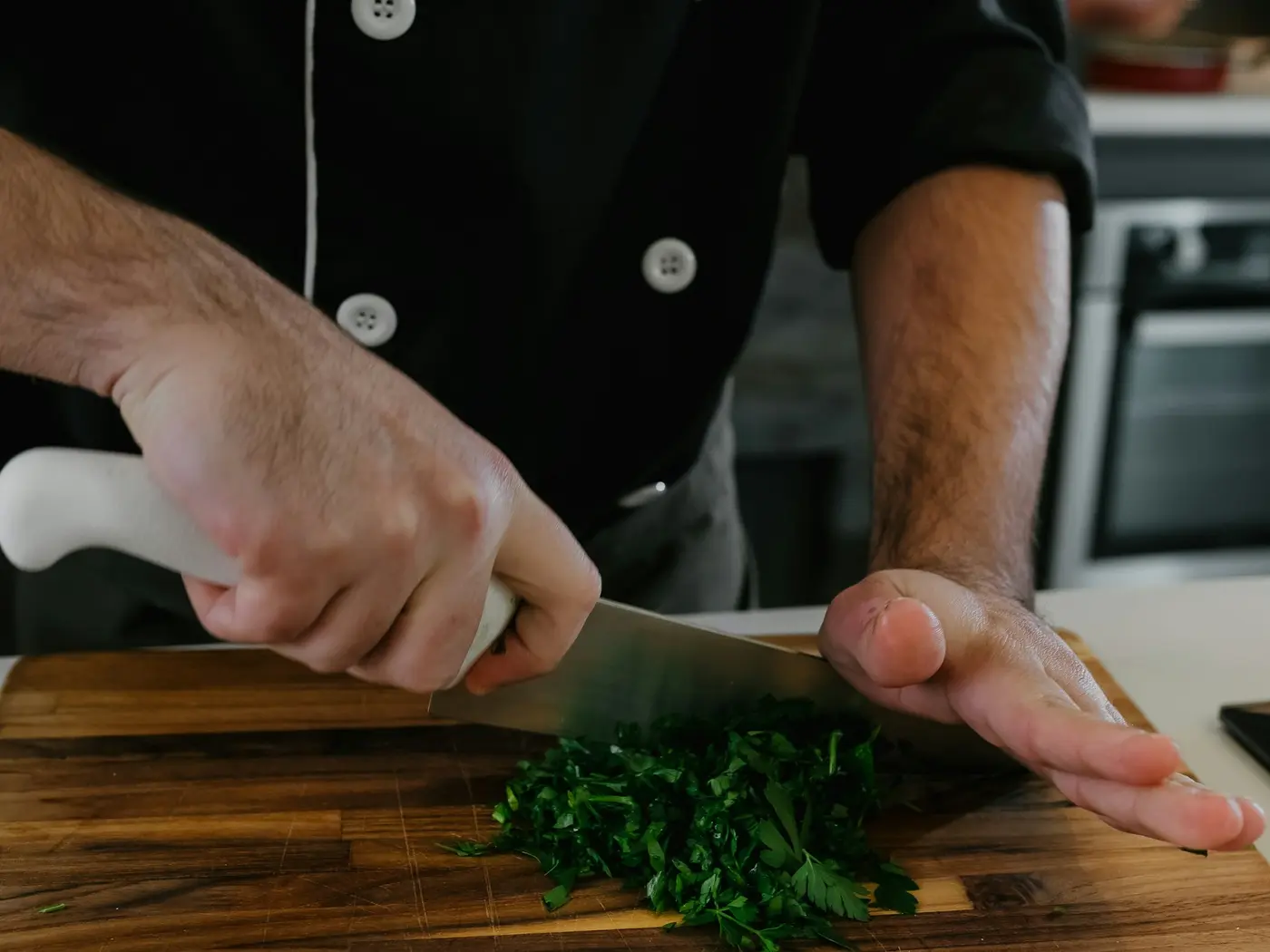
A blade with more curve supports a rocking motion. A flatter edge gives more board contact for push cutting and chopping. Neither is universally better. Think about how you naturally move and whether the tip, heel and center of the blade all meet the board during your normal stroke.
Check knuckle clearance at the heel. A beautiful narrow blade can become irritating if your fingers hit the cutting board. Also look down the spine to confirm that the blade appears straight and the grind is reasonably even.
Steel is a trade-off, not a scoreboard
Hardness, toughness, corrosion resistance and ease of sharpening pull in different directions. A hard blade may keep a fine edge for longer but can be less forgiving of twisting, bones or hard impacts. A tougher, softer blade may need more frequent edge maintenance while tolerating rougher service.
Do not pay extra for a steel name you cannot maintain. A modest knife sharpened well will outperform a premium knife with a neglected edge. Manufacturer heat treatment and blade geometry also matter, so a steel label never tells the complete story.
Handle fit and balance
Grip the knife the way you will actually use it. With a pinch grip, pay attention to the transition between blade and handle. Sharp corners, a bulky bolster or a sudden step can create pressure during long prep sessions.
Balance is preference, not a single correct point. A blade-heavy knife can help certain cuts; a neutral knife may feel quicker. What matters is that you can start, stop and change direction without fighting the tool.
What not to overpay for
Decorative finishes, elaborate packaging and large block sets do not guarantee better cutting. A full tang can provide strength and familiar balance, but well-designed partial-tang and hidden-tang knives also exist. Judge execution rather than treating one construction term as proof.
Avoid buying eight knives before you understand the first one. A chef's knife, a small utility or paring knife and a serrated bread knife cover most household prep. Add specialty shapes only when a repeated job clearly demands them.
The budget single-knife route
For most cooks, one familiar eight-inch chef's knife is the lowest-risk place to start. It gives you time to learn your preferred grip, blade curve and maintenance routine before paying for specialty shapes or a block full of knives.
The complete block-set route
A larger block set suits a household that genuinely wants dedicated slicing, bread, utility, paring and steak knives in one organized station. The trade-off is more counter space, more edges to maintain and a higher chance that several pieces remain unused.
Plan the supporting system
Use a stable cutting board with enough working area. Store the knife so the edge is protected. Wash and dry it according to the maker's instructions instead of leaving it loose in a sink or crowded drawer.
Decide how the edge will be maintained before it becomes dull. Honing and sharpening are not the same process: honing can realign an edge on suitable knives, while sharpening removes material to create a new edge. If you will use a professional service, include that cost in the ownership decision.
- Handle the knife before buying when possible.
- Check blade straightness and heel clearance.
- Choose a profile that matches your cutting motion.
- Confirm the care and sharpening plan.
- Buy one capable knife before buying a set.
Bottom line
The best-value chef's knife is the one that fits your hand, suits your motion and can be maintained locally. Spend on usable geometry and a sharp edge before prestige details.